Showing posts with label grandma. Show all posts

Wednesday, April 2, 2008

The thing about my grandma,

or one of the things, anyway, that I truly admire is that one is never in any doubt of what it is she really thinks about things. In my case, for example, I know that she thinks (a) I troddle (i.e. a combination of trotting and waddling, very difficult to achieve), (b) that I'd be surprised how many people got fat by eating too many grapes (this particular revelation happened to come while I was sitting at her kitchen table, eating grapes), and (c) my hair, if not ugly, is in sorry shape at best.

She broke this latest bit to me on Saturday. I was home for a visit and spent the morning over with her and grandpa. I gave her a hug as I was leaving, and she asked, earnest as ever, if I was going to go home to do my hair.

My hair, keep in mind, was washed and dried and even, I thought, looking pretty good. But grandma didn't and apparently she doesn't like poor Nancy Pelosi's hair either because she said mine looked like hers. That's my grandma -- just keeping it real.

Fortunately I have enough ego to handle it, and then there's this:

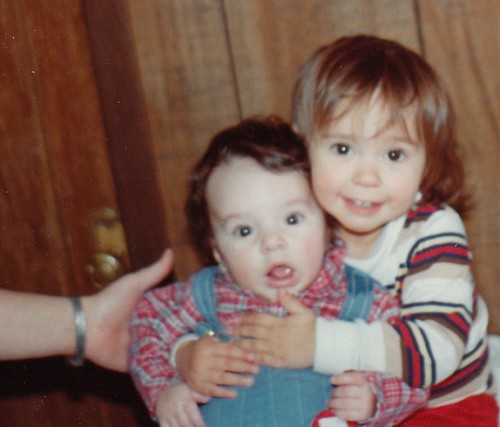
Not just anyone will hold child dripping wet from the pool, but my grandma is unafraid. That's another of my favorite things.

Thursday, February 28, 2008

I have a confession:

I don't really like meat. Never have. In other families such disinclination might be unremarkable, or even encouraged, but my people are salt of the earth meat-and-potato sorts who butcher their own beasts, make their own sausage and celebrate birthdays and anniversaries and other occasions of note with chislic (see Blackie, pictured above) feeds and prime rib. I could go on, but suffice it to say that my family really likes a good steak or pork loin or duck or even a crawdad feed. So I've worked hard to hide the fact that I don't -- disguising a paltry portion of Thanksgiving turkey behind heaps of mashed potatoes, sweet potatoes, or, God willing, a nice big serving of pretzel salad and nibbling around the well-done edge of my piece of prime rib.

Even so, I'm sure I never fooled anyone, and my mother is the only one who still harangues me about this particular failing, though it's more focused on whether I cook enough meat for J. (My grandma is just concerned that I cook enough for him, period). He's thin, you see, and there's nothing that triggers their save-the-world-one-good-meal-at-a-time instincts like a skinny man. I'd like to point out, though, that I'm not the only one in the family with meat "issues:" One of my cousins won't eat seafood because the ocean creeps her out. And there's the uncle who refuses to eat chicken or anything else that was once feathered.

For the record, I do eat meat, albeit irregularly, and sometimes I really do crave a steak, but mostly it's pork chops or white meat chicken, though I was in high school before I'd even attempt that much.

I had an intimate familiarity with the lifecycle of that fair bird, you see, and once the mystery is gone, well, it's just gone, though you have to understand that I was a particularly sensitive and squeamish child. Squeamish children don't do well with blood and guts no matter how much they want to be like Laura Ingalls and her enterprising ma making head cheese over an open fire. (Check out these brave little Laura scholars).

The whole thing got started in spring when grandma ordered her chicks.

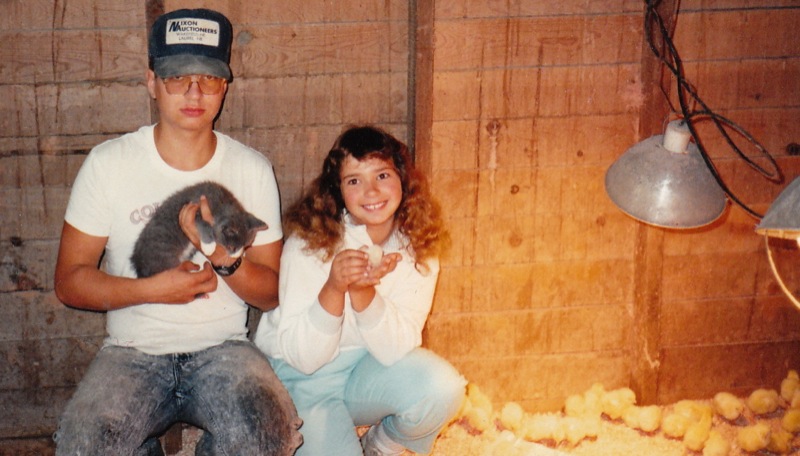
They arrived in the mail a few weeks later, all whisper soft and warm and peeping to settle in under the heat lamps in the brooder house, where they passed an awkward half-chick half-chicken adolescence with feathers gradually taking the place of down until they were mature and clucking and ready to butcher, about six to nine weeks later.

At this point, friends, grandma called together the girls, usually my mom and assorted aunts and cousins, for a butchering. I always tried to find something to play that would keep me out of sight and mind, but my mom was not so easily foiled and she was big on having me help ( I think she wanted to work that squeamishness right out of me). Part of the crew set up a propane burner in the quonset to start some water boiling. Grandma, meanwhile, slit throats out behind the brooder house and then released the chickens to flap, headless, through the weeds. One of my jobs, as I recall, was to watch where they finally flopped still and then dart through the now blood-smeared weeds to collect the carcasses.

From there they were taken to the quonset for processing. First step, plucking: We gathered around the propane burner on upturned 5-gallon buckets, newspapers spread out on the floor to catch the feathers, but first the carcass had to be swirled through the boiling water to soften the feathers. I was supposed to help pluck, but I didn't like touching the wet, warm feathers -- or the smell -- and so I did a pretty poor job of it. While I still suffer some residual guilt from that, truth be told -- I wouldn't change a thing. After the chickens were laid bare, grandma inspected them, lighter in hand, for stray barbs or any other undesirables that might need to be scorched off. That smelled awesome, too.

Then they were gutted. Again, I was supposed to help with this, but I could not stand even the thought of sticking my hands into the mysterious slippery innards of a chicken carcass, so mostly I watched. If there had been gloves, I might have done it, but requests for said gloves were dismissed as ridiculous. Besides, my cousin Heidi had no problem with the task, and that's why she's now a traveling nurse who's seen the world and I'm just a lowly humanities major turned journalist stuck at a desk all day. True, true. But the thing I remember most about this step was that grandma slit open the gizzard to empty out the chicken's last meal. It was fascinating, but sad, really; they didn't even have time to digest. She didn't save them, though; grandpa wasn't big on gizzards.

The carcasses got rinsed out, I think, and then frozen, with a few left out for eating fresh.

Blech.

To be clear, I'm not claiming this was some sort of traumatizing or even disillusioning experience. I had -- and have -- no moral or ethical objects to meat in theory. I grew up on a farm, and I knew what happened to Midnight the prize-winning sow when she didn't come home from achievement days.

In fact, I rode along with dad to take her to the locker in Freeman. And I knew why she had to go -- you didn't bring home pigs that could have been exposed to Lord knows what at the county fair, even in the name of 4-H State Fair. I'm just saying that I didn't like meat and being intimately familiar with how it went from coop to plate gave me yet another reason to be persnickety about the whole business.

But then I took philosophy in pursuit of a liberal arts education and the professor made us watch some video about factory farming.

It's the only thing I remember about the class, other than that I was always late, sat toward the front and usually fell asleep.

Still, it made me start thinking about what it means to be called to stewardship in all things, including the kitchen.

Sustainability is definitely en vogue these days, and the discussion becomes treacherous at this point, with talk of food miles, carbon footprints, organic food, local food, local as opposed to organic food, Whole Foods versus Wal-Mart versus Jane's Health Market versus the farmers' market, and, of course, Michael Pollan.

I try not to get too tangled up in all of this. I want my eggs to come from chickens with beaks, and if f I'm going to eat chicken, I'd rather she be a clucking, scratching, pecking chicken, than an oversized breast on legs that would fall over, given the space to move. I'd like my beef to be grass fed; if they have to spend time in a feedlot, it shouldn't make up the majority of their existence. Pigs need space, too, to root and roll (and perchance even fly), but if they're sick, they should be treated with all the proper antibiotics. And when it comes time for a dairy cow to be culled, it should be with the respect one living thing owes to another. (See Linda Hasselstrom's lovely work for more perspective on this topic.)

I understand that working in a packing plant could make one numb to the chores of slaughtering after a while; that's why there are supposed to be rules and regulations for the industry and inspectors to enforce them. I also understand that, ultimately, it comes down to money: The more cattle processesed, the more meat sold. And, for the consumer, too: Not everyone can afford graded beef, let alone free-range organic beef.

But for the people who can: Jamie Oliver recently butchered a chicken in front of a studio audience, to awaken British consumers to the high costs of cheap chicken, according to this article in the New York Times. "A chicken is a living thing," he told the paper, "an animal with a life cycle, and we shouldn’t expect it will cost less than a pint of beer in a pub.”

His technique follows the general idea of grandma's. And that brings me around, finally, to the point I wanted to make all along -- I had stewardship modeled for me long before I started wondering about it in philosophy class: Grandma loved those chicks destined for the chopping block; Midnight had a good life with lots of brushing and even a few baths. My brother and I had our share of bottle calves and lambs to tend, and if their names didn't end up on the package in the freezer, I have friends whose animals were honored that way. There's a rightness to that, a quiet common sense that makes its point, and all without the fanfare and theatrics involved with killing a chicken on TV.

And while I still wouldn't volunteer to pluck or gut a chicken, I do have a ring of smoked sausage from my dad waiting in the freezer for a lazy Saturday morning breakfast, should J. ever get hungry for it.

Because to be honest, I probably won't.

P.S. If you want to fix yourself some head cheese, here's a recipe. But first, watch this for pointers; she's wonderful.

Sunday, January 20, 2008

For Remembering

My grandpa drove a little diesel pickup for the better part of the 1980s. It was banana yellow, well before that color was in vogue, but even so, the most distinguishing characteristic was its brand -- Toyota.

I'm certain that in and of itself, a diesel-engine Toyota pickup, even a yellow one, wasn't all that unusual at the time, but pickup drivers in the heartland typically have two socially acceptable choices: Ford or Chevy, though Dodges are allowed in certain circles.

But gas prices were high in the 1970s and grandpa, God bless him, was even cheaper then than he is now (so I'm told), and that little pickup became his trademark as he roamed the countryside tracking the activities of his six sons.

The Toyota was tiny, especially compared to its Cummins-turbo-diesel, extended-cab, long-box counterparts, so you can understand why it might have held particular appeal to a kid, like my cousin Paul, fascinated by the idea of driving.

Growing up, Paul and I spent a lot of time together; we were the only cousins (of 18) the same age living north of town -- and later, we were the only ones horse mad. But in the early days, we spent a lot of time at grandpa and grandma's place and I remember sitting in the passenger seat of that Toyota while Paul manned the steering wheel and shifter. I can't say, however, if this particular memory is mine, or if I remember it because Paul told me about it later; he was a good storyteller, that Paul, so it's hard to say. In any case, it goes like this: We must have been about five and four, respectively, still too little to reach the pedals and this ultimately proved problematic when Paul knocked the pickup out of gear. It rolled down the slight hill in front of the house where grandpa still likes to park and was eventually stopped by the baler.

I remember the stomach-churning anxiety of those few moments of motion and I remember grandma swooping out of the house to rescue and reprimand. I remember sitting at the kitchen table eating molasses cookies after everything calmed down, but I don't remember grandpa's reaction.

We must have been banned from the Toyota because, really, what other outcome could there have been? This forced us to turn our attention to nosing around in the attic, breaking into the summer kitchen and camping out in the broke down milk truck.

Years later, properly horsed, we'd stop by the house to say hello when we were out riding. Grandma would bring out cinnamon rolls or molasses cookies, depending on what she had on hand. And if grandpa was around, he'd bring us out a pop, usually orange or grape Shasta. And then we'd be off again to carouse and scheme (i.e. daydreaming about the Jesse James gang and making up country songs, which Paul swore me to secrecy about. I'm not sure why because he wasn't shy about his other masterpieces, such as the chili dog song, which goes like this: Chili dog. Chili dog. Dog dog chili. First came the dog. Then came the chili. Chili willy willy willy willy. Repeat ad nauseam.)

After Paul got his license, grandpa gave him the Toyota. It was an unusual gift for a grandpa to give to only one of his grandchildren, but I don't remember it causing a fuss (though it could be that Paul was the only one who wanted it!). Grandpa and Paul shared a birthday, a name, and a calling -- both were born farmers -- so it makes sense that Paul would inherit his trademark pickup. Only Paul dubbed it the Yota, covered it with CB whips and crowned it, for a short time, with an intercom system. Yes. It's true and as I recall, he liked to drive by the Emery swimming pool issuing pool break edicts.

We lost Paul in October so suddenly to a disease so rare that it still doesn't seem quite real. Part of that, I know, is my vantage point: I wasn't around when he settled down with his wife a mile down the road from grandpa and grandma's farm. I never stopped in at his shop in Emery for a tour or to see how business was going. I didn't see him in his role as daddy those six brief months.

Instead, what I remember is how jealous I was of the horse he had for his cabbage patch doll. I remember convincing him to help me break out all the windows on my parents' old chicken coop. I remember bathing horses for the county show with "My Maria" playing on the radio in the barn. I remember driving around in his old green Pinto, which he had to abandon after it started on fire for the second or third time, listening to Sublime. I remember how he smeared Vicks vapor rub under his nose, even in public, to treat a stuffy nose. I remember a boy who was a little bit audacious yet so completely charming with a gift for living each moment so fully that you couldn't help but catch hold of his joy, even if only in remembering.

When I was home the day after Christmas, I stopped in to see grandpa and grandma. Paul's wife and daughter were there visiting, too, and grandpa, in deference to the baby, had the heat cranked up to 80 and grandma had pulled out the basket of toys she keeps around for the great-grandkids. Sydney was chewing on an old Real Lemon bottle -- the one in the shape of the lemon -- completely content. Megan looked soul weary and grandma looked like she'd been crying, and despite all you can say about God and his grace, sometimes your heart swells so full that words just can't suffice and you can only hope that the sheer force of your love is enough to offer some small comfort.

This is why two of the Hutterite colonies in the area fought over which one would supply the buns for the lunch after the funeral, why my uncle, who knew he couldn't bear to attend, arranged for Paul to be taken to the cemetery on the back of a pickup instead of a hearse, and why the superintendent of the school canceled classes that day.

And even though the sadness hung thick in grandma's kitchen, we sat at the table exclaiming over the baby, the calendar of family photos Megan had put together for grandma, and Donny's engagement to Sarah, the Oklahoma girl who had won grandma over with her pleasing Southern manners. And the covered cake plate on the corner of the counter had a few molasses cookies.

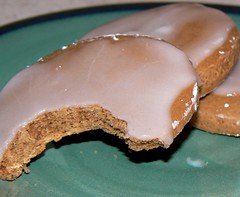
So because they're grandpa's favorites, according to grandma, because they color the background of so many of my childhood adventures, and because it's good to remember, I'm sharing the recipe with you.

Soft Molasses Cookies

(Grandma notes that "this recipe is at least 60 years old. These are Dad's absolute favorites and all the boys like them too.")
The rundown:
2 cups brown sugar
1 cup shortening (yes, shortening)
1 cup sour cream
1 cup sour buttermilk (grandma notes that this should be the "bought kind;" I don't know what store-bought sour buttermilk is, or if I'd want it hanging out in my fridge even if I did.)
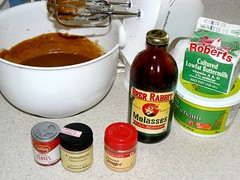
1 cup light mild molasses
2 eggs, beaten
1 teaspoon cinnamon
1 teaspoon cloves (grandma notes that one should "go easy" on the cloves; she uses a 1/2 teaspoon, but I disregarded this little tip.)
1 teaspoon ginger
3 teaspoons baking soda
8 cups flour, sifted (I didn't sift.)

The best I can tell, a full recipe will make at least 10 or 11 dozen cookies. That's a lot, my friends. Enough to feed seven kids, one husband and assorted hired hands, perhaps, but way more than will even fit in my freezer.

I made a quarter recipe, which yielded 2 1/2 dozen. I could have gotten more, but I was tired of rolling out the dough.
Since it's difficult to halve an egg, I used one. This one, from a chicken who roams the range, beak intact, and works toward the democratization of organic and natural foods by selling her wares to Wal-Mart. I like that about her.
Grandma says to mix the ingredients in the order given. But here's what I did:

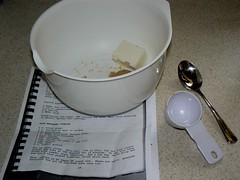
1. Cream the sugar and Crisco.

2. Beat in the egg.

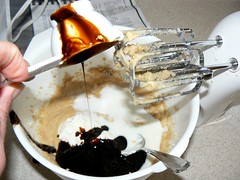
3. Add the buttermilk, molasses and sour cream.
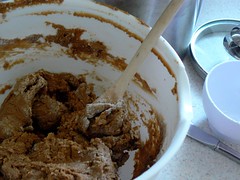
4. Add in the dry ingredients.
5. Grandma doesn't say to do this, but I recommend it: Wrap the dough in plastic wrap and stash it in the freezer while you wash up the dishes. This step is vital to an authentic molasses-cookie-making experience; grandma spent years suffering dry skin and dishpan hands without a dishwasher, too. Only she was making a hundred plus cookies at a go.

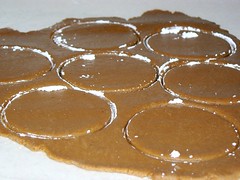
6. Once the dishes are washed, counters cleaned up and dough properly chilled, roll it out between two sheets of wax paper (but "not too thin," grandma warns).

7. Don't worry if you don't have a round cookie cutter. A cocktail tumbler dipped in powdered sugar works just as well.

8. Bake at 350 degrees for 10 to 12 minutes. (I lined the cookie sheets with parchment paper because I was out of Pam.)
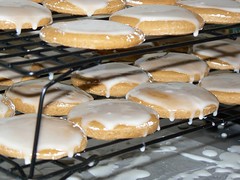
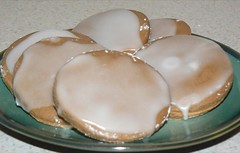
9. After the cookies have cooled slightly, frost them with a powdered sugar glaze -- powdered sugar, a little lemon juice, a little milk and a little white (corn) syrup. (I know it gets a bad rap, but I don't blame it for any extra pounds I may have carried around, and while there are a lot of areas in the Great Plains where common sense suggests wheat or pasture, I know a lot of farmers who grow their No. 2 yellow corn along with the requisite refuge acres without irrigation, in a proper rotation, using no-till or minimum-till practices. And I support them and any corn syrup they produce. So does grandma.)
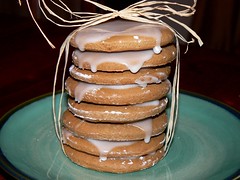
10. Then, once the frosting has hardened, you can stack them.
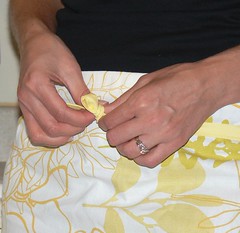
11. Or tie them with a bow.
12. And stack them again.
13. But don't forget to eat one. Or two. Or three. Or, well, you get the point. And if you have enough, you can share, but only if you want to.

When I got my Valentine's Day care package from the church ladies at Zion Mennonite during my days at NWC, I would fish these out and hoard them for myself. I shared the rest or threw them out, depending on who made them and believe me you could tell. But these. These are everything a cookie should be.

All the college kids from church got these care packages. One year Paul's was stolen -- only it turned up later in the mail room of his apartment complex, or some such place, where it had been all along. But in the interim, there were a lot of incensed church ladies as well as talk of mail fraud and revenge.

Monday, July 30, 2007

Mennonites Bake Bible, Cabbage in Bread

The church I grew up in was Mennonite in name, but at some point while I was too young to give such things much attention, it left whatever conference it was involved in (I think it was the general conference), becoming, in practice, much like other conservative, evangelical churches: We didn't baptize babies. We didn't raise our hands or clap or sing praise songs. And we certainly didn't sit around talking about our feelings. But we prayed long and hard and often -- and though communion was maybe a quarterly occurrence, we found a lot of excuses to break bread together and I still know where to find everything in that church kitchen, though I haven't been in it for almost eight years.

When I was looking for colleges, my mom wanted me to visit the Mennonite-affiliated Tabor and Bethel, even Grace. But I ended up at Northwestern College, nestled right in the middle of northwest Iowa's Dutch country. And at Northwestern I met Tonya (because we both liked the same boy. Said boy proved unsuitable for both of us, though we ended up being quite compatible). And Tonya, who was from Kansas and related to Naomi Kauffman (of all people), taught me a lot about Mennonites.

This education delved into some of the finer points of pacifism and included an introduction to Northwestern's Anabaptist fellowship group (this mainly involved hymn singing and eating, as I recall) and a briefing on some of the more important moments in our history, including the details of how Mennonites brought wheat to the Southern Plains by sewing the seed into dolls, clothing, blankets and sheets to smuggle it out of Russia.

Apparently Mennonites were good at hiding things. According to my grandma, they also baked Bibles into bread to keep them from being discovered -- and to avoid death for possessing them.

Think about that for a second. And then think about Matthew 4:4, John 1:1-2 and John 6:24-35. I have to confess that I don't know if the story is fact or fiction; it's almost too perfect an illustration; however, a) my grandma told me it's true (and doesn't that just almost always settle the question?) and b) you do have to consider that there are a lot of Mennonite breads, rolls and dumplings that have fillings: Verenicke (cottage cheese, primarily), kolaches (various fruits, cream cheese or poppy seed), bohne beroggis (pinto beans!) and beirocks (cabbage and ground beef), and those are only the ones I can name right off hand.

Until a month or so ago, I had never made beirock myself.
And I hadn't shared a kitchen with someone other than my mom (and Justin) since college and Plex 20. I didn't even realize that it was something I'd missed until I spent a Saturday afternoon visiting Tonya and Kelcee in Des Moines.

Tonya procured a beirock recipe from back home and she even typed it out, after quizzing her mom about the specifics, so that I could write about it later. Her mom is one of those sorts who makes bread by putting stuff together until the dough feels right. So you can understand the work Tonya did on my behalf.

Dough:
2 tablespoons yeast
2 3/4 cups warm water, divided
1/3 cup powdered milk
3 tablespoons sugar, divided
2 teaspoons salt
2/3 cup shortening
2/3 cup mashed potatoes (you can use instant)
1 egg
5 to 7 cups flour, or enough to make a firm dough (we used more than this because it was extremely humid)

Start by proofing the yeast. We mixed the yeast and 1 tablespoon of sugar with about 3/4 cup of warm water.

Then heat the remaining water, sugar and shortening in a saucepan until the shortening is melted.

Beat the egg and add it along with the powdered milk, salt and mashed potatoes to the butter mixture. (We used a leftover baked potato. In theory, this will work. But make sure you mash it first. We missed that step and kept picking potato chunks out of the dough...)

Stir in about three or four cups of flour with the butter mixture. Keep stirring until it's smooth. (This process goes a lot faster if you have a Kitchen Aid, like Tonya.) Keep adding flour until you get the texture you want. Even if you do have a Kitchen Aid, you'll want to do some kneading by hand so that you can gauge the consistency and texture of the dough.

Once you have it kneaded smooth, set it aside in a greased bowl to rise until double.

In the meantime, make the filling.

Filling:
2 pounds hamburger
Large head of cabbage, shredded
Onion, chopped, to taste
Salt, pepper and other seasonings, depending on your preference.

Brown the hamburger, rinse. Add the cabbage, onion and seasonings. Simmer until the cabbage is tender.

Once the dough is ready, punch it down and divide into two or three sections, depending on how much you want to work with at a time. Roll it out and cut it into 4-inch squares.

Place 1/3 to 1/2 cup filling in the middle, fold in the corners -- or fold into a triangle -- and pinch the dough together to seal it.

Bake at 350 degrees for 20 minutes or until golden brown. It should make about three dozen.

I wish I had pictures, but I forgot my camera the day we made them -- I do still have some in the freezer, so when I get them out and thawed, I'll make sure to post a few photos.

These are good, but my husband has a thing about cabbage -- and onions -- and Tonya's husband calls them cabbage cakes. I suspect that means he doesn't appreciate them as he should. Kelcee's husband, God bless him, was the only one who seemed appropriately excited about our afternoon's work.

Because I can't -- or rather, shouldn't -- eat an entire batch of beirocks by myself, I plan to experiment with some different fillings the next time I make them. Tonya and Kelcee mentioned ham and cheese -- and I wonder if a vegetable or potato filling of some sort would work too.

I've also come across a variation on the dough -- more sugar, different process for putting it together -- that I want to try. I'll let you know how it turns out.

Thursday, July 5, 2007

Rain on the Rhubarb

My dad grew up with five brothers and one sister. All things considered, this is a relatively average-sized family. But still, imagine feeding all of those growing farm boys.

From what grandma has said, dinner alone took two fried chickens (plus a hamburger or a couple of franks for the oldest boy, who's still not a fan of poultry), several pounds of potatoes and two pies to end. Besides dinner, though, there was also breakfast, two lunches (morning and afternoon), and supper, so it's little wonder that the kitchen, and more specifically, the Formica-topped table (with a couple generation's worth of chewing gum now cemented underneath) is still the place they all return to when they need tending.

Growing up, I sat at that table occupied with old puzzles and homemade play dough. I ate countless meals sitting in my dad's old place on the long end against the wall, and drank my share of pop, which grandpa doled out a half can at a time. During the summers I was home from college, I'd walk the two miles to the house, sit down for a glass of water and a visit, and unless grandpa insisted on driving me, walk the two miles back home. From that vantage point, I had a lot of opportunities to watch my grandma manage the various personalities in her family to circumvent conflict.

But when reasoning failed, she'd simply resort to this: Do you think the rain will hurt the rhubarb?

In other words, change the subject now or get out.

No one knows where she came up with it, but that hasn't stopped us from adopting it (along with grandpa's rather infamous portmanteau mental "flustration," which he used repeatedly during an interview with a local news station in the late 80s/early 90s). And I can't have rhubarb without thinking of my grandma.

Rhubarb Jam

5 cups rhubarb, chopped
4 cups sugar
4 cups sliced strawberries, blueberries or chopped cherries (or you can use a pie mix)
1 small box (6 oz) Jello in the same flavor

Combine the rhubarb and the sugar in a large saucepan and set aside until the rhubarb juices. Cook the rhubarb mixture over medium heat until it comes to a boil. Boil 15 minutes or until the rhubarb is tender. Add the fruit/pie mix and boil for 10 minutes more. Turn off the heat and stir in the Jello. Once the jam is cool, it's ready to be packaged. You can put it in jars and then refrigerate, but since it freezes well, I just put mine in freezer-safe Gladware and store it that way.

My mom and I made all three variations of this jam when I was home for a visit a few weeks ago. My personal favorite is the blueberry-rhubarb -- it's good on everything from ice cream to oatmeal, and especially fresh-baked bread.

For the record, I can't imagine that rain would ever hurt the rhubarb. It's hardy, being part of the buckwheat family and all -- and maybe that's the point.